My Story
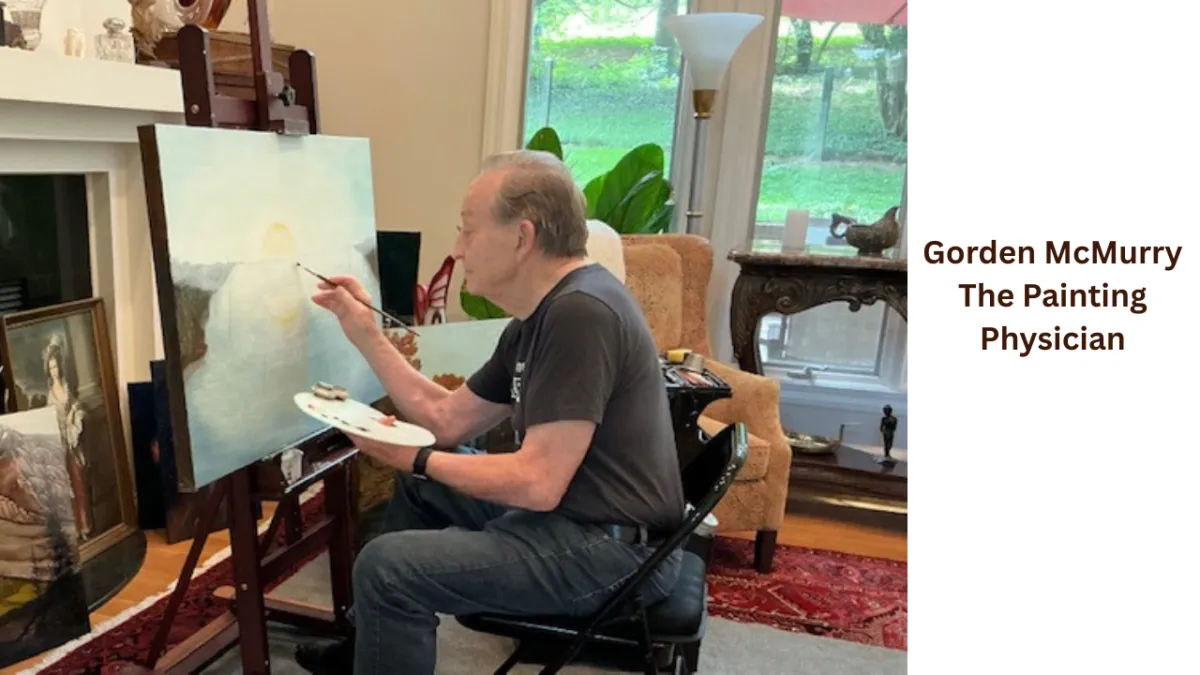
About Gorden McMurry — The Painting Physician
I grew up in rural Central Kentucky in the 1940s and 50s — a small community where artistic ambitions did not have much room to take root. There were no art classes, no galleries, no mentors.
But there was a flower garden. I started tending it when I was twelve years old. I planted it, watered it, and cared for it myself — a boy on a farm who could not explain why beauty mattered to him, only that it did.
That instinct never left me. Not once. Not for a single year of my life.
The Long Way Around
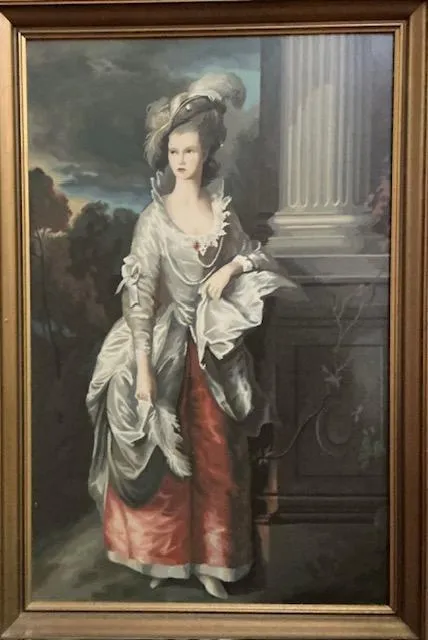
Life took me somewhere else first. Medical school. Then an internship in Southern California and then a life-changing 6 months before starting my time in the Navy. During that 6 months, while working in an emergency room, I had some leisure time for my first time since starting into medical school. I bought a Paint-By Number oil painting kit and finished it which is the picture above.
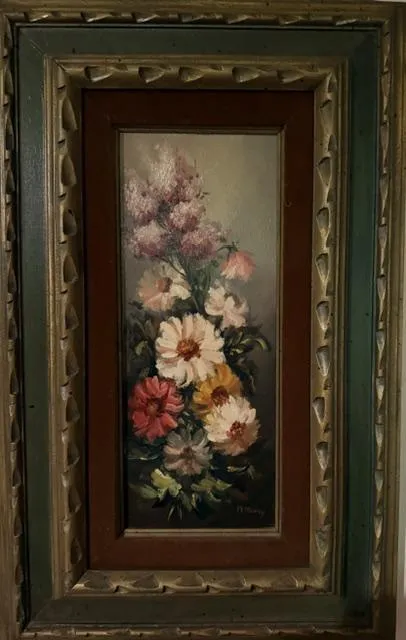
I stumbled on an art gallery owned by a artist who gave lessons and for about 4 months, each Wednesday evening, with his guidance, I learned to paint by copying masterful paintings hanging in the gallery. Here is the first of my paintings done during that 4 months.
Vietnam
Then came my Navy commission. During my years in the Navy, when painting materials were unavailable, I did crewel embroidery instead — large, complex pieces
requiring hundreds of hours of patient, disciplined stitchwork. The creative impulse does not wait for perfect conditions. It finds what is available and gets to work.
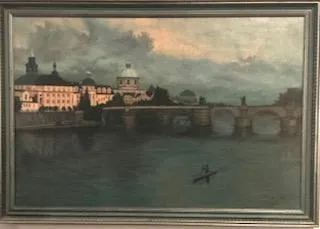
Then came Vietnam. I served as a flight surgeon on an aircraft carrier. On the voyage home, standing on the fantail watching a Pacific sunset of extraordinary beauty, I photographed it — because I knew, with the certainty that painters develop for these things, that I would need it someday.
I did. I used that sky in a painting I made in 1974 — a cityscape of Prague, where I also moved one of the buildings across the river because the composition required it. That painting hangs in my home today, a photo of that painting is below.
Medical Residency Training
After Vietnam came a medical residency, a specialization in microscopic ear surgery, a faculty appointment at the University of Louisville as chief of a new ENT residency training program, and four decades of private practice as an ear surgeon in Louisville. I retired at the age of 80.
Painting was always the plan for after. But after kept getting pushed further down the road. And somewhere in those final busy decades, I stopped painting entirely. Thirty years passed without a single canvas.
The creative life continued in other forms. I built a greenhouse onto my home and at one point was raising and caring for three thousand orchid plants. My wife Carol and I helped to run a gourmet cooking club for almost thirty years — six-course meals, the same compositional thinking applied to flavor and sequence that I apply to a landscape painting. I made floral arrangements with a painter's eye for color and composition.
I skied challenging Alpine slopes for forty years — entering the same flow state on a mountainside that I found in the operating theater and would later find again at the easel.
Yellowstone
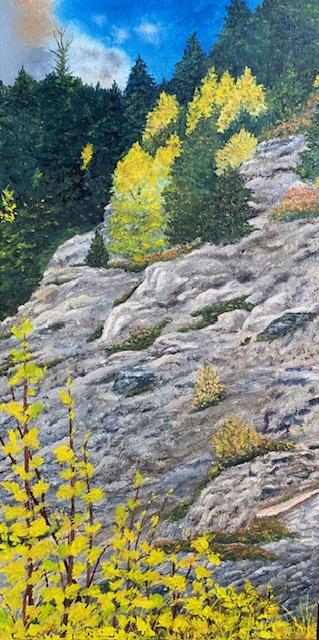
In October 2021, I came around a curve in Yellowstone National Park and the aspen trees in full golden yellow stopped me where I stood. I pulled the car over. I took photographs. And I told my traveling companion — a medical school classmate — that I had to paint that scene.
In December 2021 I went home to Louisville, found every piece of painting equipment I owned, refreshed what needed refreshing, and started again — for the first time in thirty years.
Since Then
Since December 2021 I have completed over 100 original oil paintings — landscapes, portraits, wildlife, florals, abstracts, still life, and architectural subjects. Several hang in the Kore Gallery in Louisville, Kentucky. In early 2027 I will have my first personal show, which will include a thematic series of five moon paintings titled "Moon Moods".
My wife Carol has also taken up painting since I returned to the canvas. She has lived with multiple sclerosis for over forty years and paints with compromised manual dexterity — and she produces work of genuine beauty and ambition. She chose nebulas as her subject. I could not be more proud of the paintings she has created.
The Disconnect
When I finish a painting and stand back to look at it, something remarkable happens every time. Intellectually I know I painted it. But on another level — it is hard to believe I created something so beautiful.
I have experienced this disconnect across sixty years of painting and three and a half years of serious daily work. I have come to understand that it is not self-doubt. It is the signature of genuine creative flow — the experience of a work that came through you rather than from you.
That feeling is what I want to give every student I teach.
What I Teach
I teach landscape painting — not because it is the only subject worth painting, but because it is the most complete training ground in all of oil painting. Every fundamental skill a painter needs can be learned through landscape painting and then applied to any subject: portraits, wildlife, florals, abstracts, still life, architecture.
The landscape is the vehicle. Oil painting is the destination.
Before we ever discuss brushes or paint or canvas, we begin with observation. With truly seeing. With the understanding that the difference between a flat painting and a beautiful one is not talent — it is how deeply you have learned to look.
I spent fifty years as a surgeon teaching complex procedures to medical residents. You do not learn microsurgery by watching a master and hoping inspiration strikes. You learn by understanding the sequence, practicing each step, over and over again in a laboratory, and building confidence through repetition.
Painting is the same.
There are four disciplines that have defined my life — and in each of them, I have experienced the same thing.
In a surgical theater. The preparation complete. The instruments ready. The procedure beginning. I would take a breath, make the first incision, and feel the shift — the conscious planning mind stepping back, the trained hands taking over, the work proceeding with a kind of quiet certainty that I could not have manufactured by trying harder. Fifty years of surgery. That shift happened thousands of times. It never lost its quality.
On a ski slope. Forty years of standing at the top of a challenging run and facing the same choice. I could stand there worrying — cataloguing the risks, second-guessing my ability, rehearsing what could go wrong. Or I could take a few deep breaths, push off, and trust that forty years of conditioned reflexes in my legs and feet knew exactly what to do if I stayed out of their way. I always pushed off. I always got down the hill.
In my garden. In my greenhouse. Standing before an orchid that is struggling and trying to understand what it needs. I have tended a flower garden since I was twelve years old on a farm in Kentucky. I built a greenhouse onto my home in Louisville and at one point was raising and caring for three thousand orchid plants simultaneously. My current garden grows two palm trees in a climate that should not support them. They are, against all reasonable expectation, thriving. Growing things requires exactly what surgery requires — patient observation, sensitivity to light and color and temperature, the willingness to see what is actually there rather than what you expect to find. I have never stopped doing this. I never intend to.
And in my living room in Louisville, standing in front of a canvas. This one surprised me most when it returned — because it had been thirty years away. The sketch done. The composition transferred. The structural decisions made on paper where they cost nothing to get wrong. I pick up a brush. And the same thing happens. The shapes arrive without my consciously placing them. The details come without my thinking about them individually. I am not planning. I am not calculating. I am simply painting — and the painting is happening through me rather than by me.
Four disciplines. Eight decades. One experience — lived not once, but continuously, across an entire life.
Take a breath. See what is actually there. Trust what has been prepared. Get out of the way.
For You
My introductory landscape painting course is designed for retiring and recently retired professionals and executives who have always wanted to paint and are finally ready to begin. No prior experience required. No special talent required. Just the desire to create something genuinely beautiful — and the willingness to truly learn to see and take the time to learn the basics.
I turned 86 in November of 2025. I returned to painting at 81. I tell you this not to impress you, but because I know what is holding you back. The feeling that it is too late. That too much time has passed.
It has not. It never does.
The window is not closing. It has always been open.
Push off down the hill.
Gorden McMurry — The Painting Physician
Oil Painter · Landscape Painting Instructor · Ear Surgeon (Retired)
Kore Gallery, Louisville, Kentucky
gordensoilpainting.com · [email protected]